How to panelise small PCB’s
- When using break-routing keep your overall panel size small : don”t put too many small PCB”s in a panel
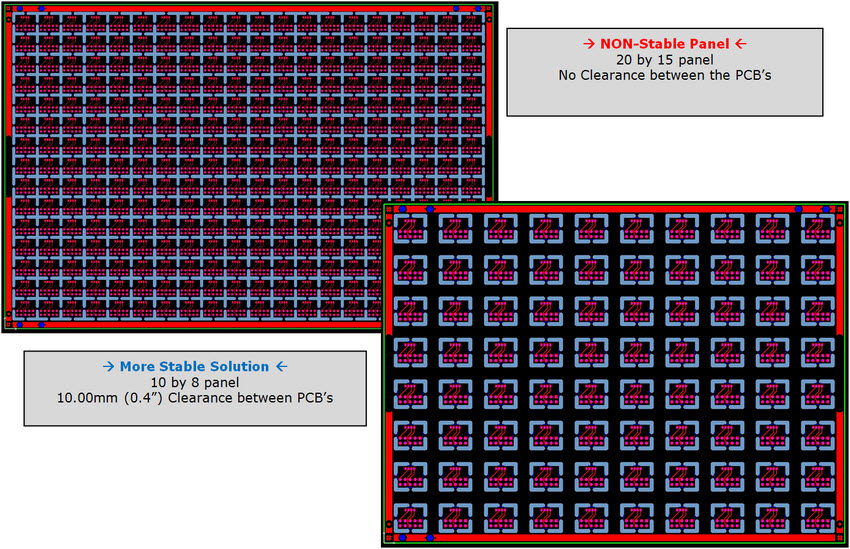
- The more small PCB”s you put in a panel, the more material will be cut away from the panel. This makes your panel increasingly weak. Typically large break-routed panels made up of small PCB”s tend to bend through when held horizontally.
- To prevent this sagging, and to increase the overall mechanical stabiltiy, add extra material between the PCB”s.
- Also consider that the cutting tool has a width of 2 mm. – A bigger clearance then 2 mm will not necessarily increase the stability. For instance a clearance of 5 mm results in 2 x 2 mm from this clearance cut away, so only 1 mm is left. This is not helping the panel stability at all.
- We recommend a minimum clearance between small break-routed PCB”s of 10.00 mm.
- Choose a wider panel border for extra strength.
- Remember also that when using break-routing we need to place break-out-tabs on the PCB in both X and Y direction. Defining the routing tabs on smaller PCB”s can be problematic or even impossible as the routing tabs require a minimum accessible length of 5.00 mm for proper placement.
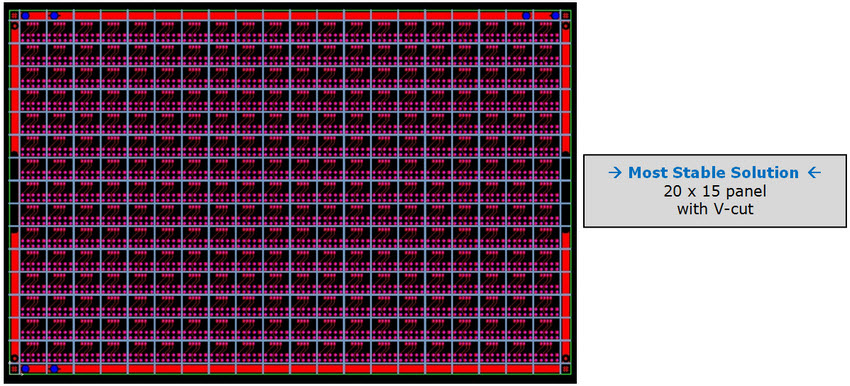
- In many cases the best solution for the panelization of small PCB”s to ensure good mechanical stability is to use V-cut ( scoring) as the board separation method.